editor's note: all pictures used are a mix from the afternoon - 6 PM (full gold suit), and the evening at 8 PM (black pants) shows.
_JPG.jpg)


“Elvis in Toronto - Ontario, Canada at Maple Leaf Gardens, April 2, 1957”
By Kevin Plummer 2013, The Torontoist.
“It goes without saying,” Toronto Star music critic Hugh Thomson wrote in a scathing review of Elvis Presley’s two-concert appearance at Maple Leaf Gardens on April 2, 1957, “he has all the appeal of one-part dynamite and one-part chain-lightning to the adolescent girls, but to one like myself who is neither a girl nor adolescent, I could only feel he was strikingly devoid of talent.”
_JPG.jpg)

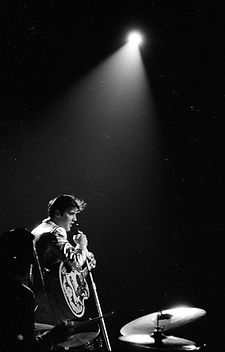


Maple Leaf Gardens Toronto Canada April 2, 1957. Toronto news photographer Lou Turofsky
While a frenzied audience (reportedly composed predominantly of women, ranging in age from four to 64) screamed and cheered in approval as Elvis glided across the stage, seductively cradling the microphone and stopping to rock his hips in rhythm to the music, Thomson seethed: “One rock ‘n’ roll ballad sounded just like the other, and the basic theme and appeal were sex, which Elvis lays on with the subtlety of a bulldozer in mating season, you might say. He is Mr. Overstatement himself. He has to knock himself and his audience out at every beat.”

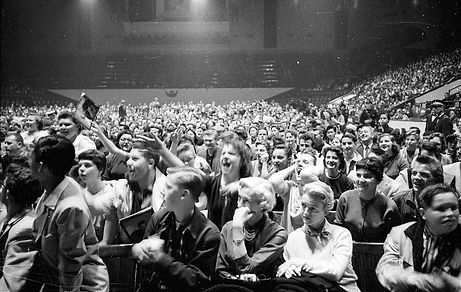
Elvis’ appearance in Toronto was credited, in the Toronto Telegram, to the efforts of Leaside’s Carol Vanderleck, who mailed off a petition with 2,443 signatures asking him to perform here. The Star suggested responsibility rested with another fan, Shirley Harris, who with the aid of a local radio show collected 2,000 signatures of her own. And it was widely reported in the Canadian press that, on a per-percentage basis, Elvis received more fan mail from Canada than from anywhere else. But it was Vanderleck who Colonel Tom Parker, Elvis’s manager, called personally to announce an upcoming concert at Maple Leaf Gardens.

Elvis Presley delivered only five performances outside the U.S. during his career. All five took place in Canada in 1957. The King did two shows in Toronto on April 2, two more in Ottawa on April 3 and one in Vancouver on August 31. In Toronto alone, more than 23,000 screaming, adoring fans packed Maple Leaf Gardens to see their idol – with over 100 police on hand to keep order. It was the biggest thing to hit Hogtown before the Maple Leafs won the Stanley Cup in 1967. And it was mainly due to the efforts of a young Leasider named Carol Vanderleck.
Like many teenagers of her era, Carol worshipped Elvis Presley and his music. In 1956, after watching his first film Love me Tender, she was determined to bring her hero to Toronto and launched a petition designed to make her dream a reality. Within three months she had obtained more than 2,400 signatures, which she then sent to Elvis’s manager, Colonel Tom Parker. Impressed by her effort, Parker phoned her personally to say that Elvis would indeed perform in Toronto in early April. As quoted in Brandon Yip’s Elvis Presley: “All Shook Up” in Canada, Carol recalled in 2000, “You can well imagine how exciting, if not overwhelming, this was to a star-struck, typical 14-year-old girl.”
Carol Vanderleck and Elvis, backstage at Maple Leaf Gardens, April 1957. Photo Toronto Telegram.
The excitement, however, was just starting for Carol. The Toronto Telegram picked up the story, and on March 20 printed a front-page article, with Carol’s photo, crediting her with bringing Elvis to Toronto. This was quickly followed by an invitation to meet Elvis backstage after his press conference on the night of his performance. An Ontario shoe manufacturer named Robert Woolley had acquired the rights to make Elvis Presley ballet shoes, and he wanted Elvis to present a pair to Carol as part of an advertising campaign and photo op, as journalist June Callwood wrote in Chatelaine magazine.
Carol was ecstatic. But as she later recalled, she remembered nothing of what Elvis said to her when he presented her with the shoes. (He apparently said, “Here you are, honey; wear these for me.”) She also remembered very little of the concert itself other than the screams of the audience and that Elvis wore a gold lamé suit during his performance. (As it turned out, this would be the last time Elvis ever wore the full gold suit on stage.)
What Carol did remember vividly was the way Elvis moved – not just on stage, but especially during his press conference, which he conducted while sitting on a table. As quoted in Brandon Yip’s book, she said: “He truly was like a big black panther, and his eyes sparkled and shone . . . He was lithe and strong, and he was fast.”
A few months later, after all the pandemonium had subsided, Carol’s experience was documented and analyzed in detail by June Callwood in Chatelaine.
Callwood’s piece strongly suggested that “Carol will outgrow Presley long before she outgrows her new tartan suit” – a reference to the outfit Carol wore when she met the King backstage.
But the writer was mistaken.
Like millions in Canada and around the world, Carol remained devoted to Elvis virtually her entire life. Thirty years after the Toronto performance, she still treasured the photos of Elvis giving her the shoes. And in 2000, she boasted that she had turned her 85-year-old father into an Elvis fan.
Carol Vanderleck died in 2011 and is buried in Mt. Pleasant Cemetery. Following her death, her niece Sarah posted this touching online tribute: “I couldn’t ask for a more exotic, interesting, mysterious and intelligent aunt. Like Elvis, your legend will live on.”
Photos: COLOURIZED COVER AND ORIGINAL B/W PIC: YORK UNIVERSITY LIBRARIES, CLARA THOMAS ARCHIVES & SPECIAL COLLECTIONS, TORONTO TELEGRAM FONDS, ASC00834. AD: TORONTO TELEGRAM, MARCH 24, 1957. REPORT CARD: LEASIDE HERITAGE PRESERVATION SOCIETY.


With one hit song after another through 1956, Elvis skyrocketed in popularity and, Jerry Hopkins suggests in Elvis: A Biography (Warner Books, 1971), Parker was loathe to continue to give his star property away for free on television. So Parker organized a money-making tour in the spring of 1957, starting in Chicago and including stops in Fort Wayne, St. Louis, Philadelphia, and Buffalo. His appearances in Toronto and Ottawa on this tour — and a subsequent engagement in Vancouver later that summer — would be Elvis’ only live performance outside of the United States in his career.


.jpg)


March 28, 1957. International Amphitheatre Chicago, Illinois
Elvis Presley at Kiel Auditorium, St. Louis, March 29, 1957. Creator St. Louis Globe-Democrat
Allen County War Memorial Coliseum Fort Wayne Indiana March 30, 1957
Olympia Stadium, Detroit, MI., Sunday, March 31, 1957
Buffalo Memorial Auditorium, Buffalo, New York. April 1, 1957
Elvis had only released his first single, “That’s All Right,” four years earlier; his popularity exploded rapidly, with numerous television appearances and Hollywood films in 1956 and early 1957. Still 10 months away from being drafted into the army, Elvis was at the peak of his early career. Everywhere he made a personal appearance, bedlam ensued.


“It generated coverage, controversy, and cash, and from nearly every point of view could not fail to be accounted a success,” Scotty Moore, a member of Elvis’s backing band, recalled of the March–April 1957 tour. “But if anything was needed to confirm the Colonel’s growing conviction that this was a phenomenon that had orbited out of control…this tour served to do it… It was becoming increasingly impossible even to do the show.”


The first in line for tickets when they went on sale on March 20 was a 13-year-old boy, who showed up at 5:45 a.m.; the Maple Leaf Gardens box office didn’t open until 10 a.m. With prices ranging from $1.25 to $3.50 a seat, tickets sold out within 48 hours. Elvis and his handlers quickly agreed to a second show: the tickets that had already sold would be honoured for a 9 p.m. show, and a 6 p.m. performance would be added.

.jpg)
The first major rock ‘n’ roll event in Toronto had come almost a year before, when Bill Haley and his Comets performed at Maple Leaf Gardens. But where Haley—a jovial and portly singer approaching middle age—might’ve been accepted as relatively innocuous, for moralizing politicians, preachers, and parents, Presley represented a dangerous new youth culture.
.jpg)
Bill Haley and His Comets in 1956. Left to right. Rudy Pompilli, Billy Williamson, Al Rex, Bill Haley, Johnny Grande, Ralph Jones, and Franny Beecher.
.jpg)
Canadian critics, like American critics before them, commented on his suggestive stage movements; his noisy (to older ears) fusion of country and rhythm and blues; and, most importantly, on the response the heartthrob singer provoked among his young fans.
Journalist Barbara Moon gave Toronto religious leaders free reign to vent about Elvis in Maclean’s (July 7, 1956). Jan Scott, religious columnist for the Toronto Telegram, insisted that teenagers who listened to rock ‘n’ roll would inevitably regret it once they realized “the whole business of pleasure-seeking and self-indulgence was a mockery and a sham.” Reverend W.G. McPherson of the Evangel Temple proclaimed that rock played on emotions “like the music of the heathen in Africa.”
“Elvis Presley is a vulgar, tasteless amateur!” exclaimed Rudolf Bing, general manager of the Metropolitan Opera Company, who happened to be visiting Toronto in late March. He was pressed by Toronto reporters about whether there was at least something entertaining about Elvis’ on-stage antics. “No,” he sternly insisted. “I find this no laughing matter. It is a desperate state of affairs when you consider millions of youngsters being brought up on horror comics and Presley.”


Presley didn’t do himself any favours in the face of critics claiming a link between the singer and juvenile delinquency when he got into an altercation on a Memphis street a few weeks before the show. While signing autographs, Elvis was confronted by an 18-year-old U.S. Marine alleging the singer had bumped the soldier’s wife months earlier. Guileless, Elvis pulled out a Hollywood prop pistol, and with a broad grin on his face exclaimed: “I’ll blow your brains out, you punk.”
‘It was all a misunderstanding,” Presley explained after the matter was resolved amicably through a Memphis judge’s mediation. “We’re both sorry it happened. I thought he and his buddies were trying to beat me up.” However minor, the widely reported incident served to underline the danger Elvis and his rock ‘n’ roll ilk posed to North America’s youth.

_JPG.jpg)
In ’57 a Pistol-Packing Presley Threatened a Marine in Memphis
“I’ll blow your damn brains out, you punk.” That’s what Elvis Presley told a young marine on March 23, 1957. At least that’s what 18-year-old PFC Hershel Nixon alleged Elvis said as the rock ’n’ roller pointed what looked like a 25-caliber pistol at the marine. Presley denied he made the comment, and the gun turned out to a “toy.” Although no charges were filed, and both men later apologized to each other, the incident made national news.
It was the third time in six months that the 22-year-old Presley had made the news for such confrontations. On October 18, 1956, Elvis was arrested for assault and disorderly conduct after a fistfight with two gas station attendants in Memphis. A judge threw out the charges the next day. Then, that November he was involved in a brief barroom fracas when a jealous husband challenged him to a fight. Blows were thrown but neither man was injured. Again, Elvis was exonerated.
The episode with the marine only increased the public perception that Presley was as reckless on the streets as he was on stage. It was an image that fueled his young fans’ adulation and added to the conviction of community leaders that Elvis had a harmful influence on teenagers.
While the Telegram, for its part, initiated the Elvis Suppresley Club, there were among the Toronto media those who defended the singer and his teenage fans. “There is far too much gratuitous insult handed out these days to young people regarding what they like or don’t like, and the guilt-by-association technique had been over-used already on the many decent youngsters who genuinely like Presley even to the point of imitating his haircut,” Globe and Mail columnist Scott Young wrote thoughtfully, placing Elvis within a longer history of youth culture and mothers who’d swooned over Rudy Vallée (and fathers sporting coon coats) in their younger years. “And in 20 years, some vital young man with long hair or no hair at all will come along playing a bassoon or a Tibetan lute and will fill Maple Leaf Gardens with the sons and daughters of the people who will be there to hear Elvis Tuesday night,” he concluded. “And the veterans of this Elvis recital, away off there in 1977, will sit at home and stare into their coffee cups and wonder what the world is coming to.”

.jpg)
When they finally met him in person—as Star staffer John Beehl did when Elvis kicked off the tour in Chicago in late March—journalists were surprised to discover a boyish but respectful, soft-spoken young man, who didn’t drink, smoke, or swear, rather than the caricature described at so many pulpits.
“If I thought I was contributing to juvenile delinquency or causing anybody to go astray,” Elvis said when a Canadian reporter gave him an opportunity to answer his critics, “I’d go back to driving a truck.” Of his provocative performances, he added: “When I start to sing I’m carried away, I spread my feet apart, pick the guitar, and the rhythm carries me from there. I can’t help movin’ around. It’s the way I sing.”
In the weeks leading up to Elvis’s arrival, the Toronto press carried dozens of stories on Elvis and his local fans. The Star visited the kids of Presley Avenue in Scarborough. “Kids keep asking me all the time if I really live on Presley Ave.,” one 14-year-old resident and Elvis fan commented. “When I tell them I do, they practically swoon. ‘Oh I wish I lived on Presley Ave.’ they say.'” The Globe and Mail featured a photo of two East York teens, Helen Hagen and Judi Reilly, who’d composed a song in Elvis’s honour. Radio stations held contests for the chance for young listeners to meet Elvis in person.


Elvis Presley performed a two-day, four-show stand at the Philadelphia Sports Arena on April 5 and 6, 1957. The concerts are remembered for both intense fan hysteria and memorable backstage altercations, including a bizarre egging and tomato-throwing incident by local college students.
The two-day, highly publicized stop in Pennsylvania featured several key moments.
Show Details: The 6,500-seat arena was only about half-full for his first show, but the crowd’s sustained, high-pitched screaming completely drowned out his vocals.
The Egg and Tomato Incidents: During his evening shows, Elvis's guitars were targeted by projectiles. One night, a hurled tomato hit his guitar and snapped the strap, causing an angry Elvis to offer to fight the thrower. The next night, male students from Villanova University threw eggs at the stage, with one cracking directly into Elvis’s guitar and putting it out of commission.
The Star dispatched Don Carlson to Memphis to pen a three-part biographical profile of the singer, recounting his rise from Memphis truck driver to rock ‘n’ roll sensation in less than four years. Carlson was astonished by the money-making yield of what he dubbed “Elvis Incorporated.” Selling records at a rate of a million per month, he said, earned Elvis about $1 million in royalties annually from his record deal with RCA Victor, television appearances added $100,000 per year, and personal appearances another $25,000 per week. Hollywood commitments added between $100,000 to $250,000 per movie on a three-films-per-year contract. Carlson further cited conservative estimates that consumers spent $25 million each year on products bearing the singer’s likeness—such as scarves, busts, shirts, pyjamas, and lunchboxes—and Elvis-endorsed products like cosmetics and soda pop.


.png)
.png)
.png)
Prior to the 6 p.m. show, perched on a table in a concrete room in the bowels of Maple Leaf Gardens, Presley chatted with the journalists who were there to cover his performance. Wearing an open-collar silver metallic silk shirt and a red suede jacket, he impressed most of them with his natural charm, humour, and ease at responding to questions about his critics, his love life, his taste in women, and his multi-faceted career—which most reporters in attendance assumed would be over in short order.

.jpg)

.jpg)
.jpg)
.jpg)
Had he ever thought of becoming a doctor or psychiatrist, one journalist asked. “I haven’t thought about becoming a psychiatrist, but I’ve often thought of going to one,” came his quick-witted response. Asked about formal musical technique, Elvis playfully conceded: “I don’t know anything about music—in my line I don’t need to.” He admitted to experiencing regular stage fright, despite the crowd’s howling enthusiasm. “It’s the waiting part that gets me,” he told one reporter. “It’s not so bad once I’ve done the first couple of numbers. But I’m never completely at ease.”
Other reporters, while undeniably impressed by Presley, thought his charm dangerous. “After seeing Elvis in action the question is not what’s going to happen to the teen-age squealers who undoubtedly will recover their equilibria, but what will become of this Bible-reading, non-smoking, non-drinking boy who is so good to his mother,” the Star‘s Angela Burke pondered after the press conference. “For the trouble with Elvis, from this observer’s view,” she added, “is young Mr. Presley’s complete lack of naiveté. Even the way he handles himself in a press conference, parrying questions sometimes with humor, and sometimes with remarkable innuendo, is a shocker when one considers his age.”


Out in the arena, the crowd grew restive sitting through a half dozen opening acts. An hour-long revue featuring tap dancer Frankie Trent, singer Pat Kelly, standup comic Rex Marlowe, and banjo player Jimmy James culminated in a chorus of boos for Irish tenor Frankie Connors. Only a solo set by the Jordanaires, Elvis’s backup singers, was well-received by the impatient audience.
After a 20-minute intermission, when the house lights dimmed and a local disc jockey announced Elvis’s imminent arrival on-stage, the crowd shrieked at top volume for 30 seconds straight. “From there on the Gardens,” the Globe and Mail recorded the scene, “from floor level to the highest tier, became a din of shrieks, whistles, feet-stomping and handclapping, lit by the chain lightning of amateur photographers’ flash bulbs.”
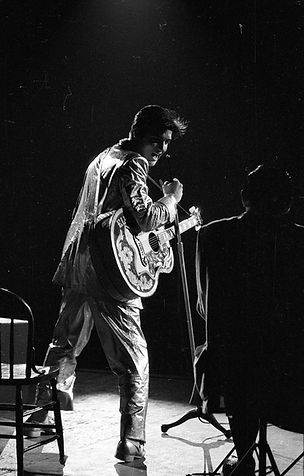
But, having broken a guitar string or hit himself in the eye with a microphone (accounts vary), Presley was further delayed en route to the stage. “Elvis doesn’t think you’re making enough noise,” came another announcement over the PA system, and the thunderous cheers from the crowd grew louder still. When he finally emerged on stage—dressed in the famous Nudie Cohn-designed gold lamé suit he’d introduced at the start of the tour—the ear-splitting noise prevented any one from hearing Elvis actually sing. “It was Presley a la pantomime all the way,” the Globe and Mail reported, “but nobody seemed to mind.”


“Up and down the stage he goes, dragging the mike like a captive, undulating, shouting feverishly,” wrote organist Charles Peaker, who attended the concert at the invitation of the Star. “He freezes, the orchestra stops—he glares at the audience like one in a hypnotic trance, then he leaps, gives tongue, and starts to dislocate his golden legs again.” Providing the most colourful descriptions of Elvis’ performance carried in the Toronto press, Peaker continued: “Then his face sets, his lips curl back and seizing the mike by the scruff of the neck he prowls up and down the platform, snarling, and driving his worshippers crazy.”


.jpg)
Whenever Presley smiled seductively to one section of the audience or stretched out his arm towards another, the affected spectators erupted with ecstatic screams. His guitar was more prop than musical instrument. “At times he even balances on both toes with his knees forward, hips wiggling and chest thrown out,” reporter Joe Scanlon recalled. “The position appears physically impossible to hold, but Elvis manages to stay that way for 15 or 20 seconds.” None of the stage movements were choreographed or ever the same from concert to concert, which caused problems for his backup singers. “So we’d be watching,” one of the Jordanaires, Gordon Stoker, recalled of this tour in Hopkins’ biography of Elvis, “and we’d be watching so hard we’d blow the part, we’d forget to come in with the ‘ooooowahhhh’ and he’d turn around and give us the lip—you know the way he moves the left side of his mouth in a cocky sneer—of he’d say something like ‘oh yeah?’ or ‘sumbitch.'”
Among those 23,000 who attended Elvis’s Toronto concerts were several local celebrities including TV comedians Wayne and Shuster—who characterized Elvis as “sort of an E.P. Taylor with sideburns”—and Toronto Symphony Orchestra conductor Walter Susskind. “I feel that Mr. Elvis Presley is everything he is reported to be,” Susskind summarized. “Unfortunately, I could hardly hear him, so I cannot comment myself further.” A contingent from the Toronto Town Jazz Club attended “out of curiosity.” “What a horrible experience,” club president and jazz critic Dave Caplan complained. “I came to find out what all the noise about Presley is about; and that’s just what it all amounted to—a lot of noise.”


_JPG.jpg)
Even The Famous Aren’t Immune
By Lillian Foster, Toronto Telegram, April 3, 1957
A dancer who has had audiences swooning over her since she was 17, almost swooned herself last night when she met Elvis Presley. Mia Slavenska in town for two weeks entertain at the Royal York visited maple Leaf Garden last night to met the sensation of show business. Elvis had never heard of the famous ballerina – but she had heard of him, as who hasn’t, and was thrilled to be asked to pose for a picture with him. Mia Slavenska has her husband and little daughter, Maria, in town with her for her opening performance tonight. They drove all the way from New Jersey.
Elvis and ballerina Mia Slavenska
Elvis And The Medallion
Super-fan, Carol Vanderleck, fourteen, an intelligent, even demure high-school student who collected three thousand names on a petition begging Presley to visit Toronto.
When she met Elvis backstage before the first show, she gave Elvis a large medallion that Elvis wear on stage the same evening in Toronto and later in Ottawa, Philadelphia, Spokane and Tupelo.
%20with%20Carol%20Vanderleck_.png)

Evelyn Dumas, a twenty-something from Saskatchewan working for a Toronto family, was gifted a front row ticket by her employer. Slightly older than the majority of the teenage audience, she nevertheless gave in to girlish exuberance: “Although I was never one to do it—he walked on that stage, pointed his finger, began singing—and I screamed, just as loud as the rest of the girls in the audience that night! I was spellbound.”
.png)
A DATE WITH ELVIS . . .
leaves six Toronto girls almost ”flipping.” They won the change to meet their idol tonight in a radio station contest.
Rear are Valerie Stewart, 18, and Beverly Ross, 19, middle, Gail Cameron, 17, and Katharine Schneider, 18, front Toyoko Sameshima, 16 and Edna Manitowabi,16.
Lucky Valerie Stewart and four of the other contest winners was thrilled when she was photographed with Elvis backstage in the Maple Leaf Gardens.
Elvis performed most of his hits, all except “Blue Suede Shoes.” He treated the audience to “Heartbreak Hotel,” “Don’t Be Cruel,” “Love Me,” “Too Much,” “That’s When Your Heartaches Begin,” and “All Shook Up”—which would be the number one record on the very first CHUM chart on May 27, 1957—as well as some lesser known songs like the not-yet-released “One Night,” and “Butterfly,” which he never formally recorded.
As raucous as the gathering appeared, members of Elvis’s entourage told Toronto journalists that “the whooping and hollering and shenanigans just didn’t compare to what they had seen in other cities.” Just the night before, in Buffalo, a woman had clutched the singer until a blow from a policeman’s club broke him free. Toronto police, under the command of District Chief George Elliott, took no chance of a repeat, stationing as many as 125 uniformed police officers around the arena to spot trouble before it started. “Whenever a youngster bounced up in his seat a policeman would reach over and plunk him down again,” the Star‘s Scanlon observed. “This sometimes gave the Gardens the appearance of a large jack-in-the-box but it seemed to have the desired effect.” Two young female fans were ejected that night when they rushed the stage. In addition, the Globe and Mail noted “a scattering of fainting women.”
Surveying the scene from the back of the stage, Elliott, satisfied that the crowd was well-behaved, was seen tapping his foot to the music. “I’m a bit of a Presley fan myself,” he later told the press. “They were a good bunch,” Elliott said of the audience, which avoided the ugly scenes witnessed elsewhere at Presley performances—like that in Vancouver several months later, when the concert was cut short because the crowd rushed the stage. The most difficult task of the night for police was clearing the arena after the early concert so that those with tickets for the 9 p.m. show could take their seats.
.png)

In between performances Elvis rested backstage, lying down in his dressing room for a period and meeting some lucky fans, including Vanderleck and Harris, whose petitions had led to the concerts in the first place. Meanwhile, clean-up men filled and carried away boxes and boxes of used flashbulbs collected from the arena floor.


The early show proved to be the last time Elvis wore the full gold lamé suit. His performance style, regularly dropping to his knees, had quickly worn down the gold on the front of the pants. Other than that detail, the second show went much the same as the first. With 15,000 fans now jammed into Maple Leaf Gardens the crowd’s hollering once again drowned out the singer and his musicians. As he neared the end of another hour-long performance, Elvis was drenched in sweat, his hair disheveled. One reporter in attendance likened him to “a kid staggering after a tough basketball game.”


He closed the show with “Hound Dog,” repeating chorus after chorus a dozen or more times in a growing crescendo. And then, an instant after the last notes were played, he was gone. For his own safety, Elvis never did encores or lingered at the venue. Before the audience could react—still hopeful there’d be a curtain call—he bolted off-stage and into a waiting car. “I’ll bet that guitar hadn’t hit the stage from his hand by the time he was shooting through the door,” one Toronto police officer observed. “His fast disappearance made it a lot easier for us.”

Girls, 4 To 64, Enthralled By Elvis Presley Visit
Toronto Daily Star, April 3, 1957
Women from four to 64 visited Maple Leaf garden last night to hear Elvis Presley and most of them went home satisfied with what they have seen. Only complaint came from those who liked to hear Elvis sing. The screaming prevented that. Mrs. Joyce Lindsay, 35, Hamilton, said: ”Now I’ll have to og home and play Presley’s records. I couldn’t hear anything for all that screaming. ”I really would have liked to have heard more singing and less screaming. ” she said. ”But the kids were pretty well behaved, I thought. I like it.” Mrs. Lila Marr, 62, who was accompanied by her granddaughter, Heather Wilson, 12, admitted she, too, was a Presley fan. ”Heather didn’t have to encourage me to come.” she said. ”I like Presley’s records very much. I thought it was a good show. That kid’s got something.” Mrs. Marr, however, agreed with Mrs. Lindsay that there had been a little to much screaming. But 18-years old Elana Cross had no complaint at all. ”I thought it was wonderful. I loved it.” she said. Phyllis Morrell, 12, Hamilton, also liked the show. ”I’m glad I came, ” she said. Perhaps the youngest fan there Wasa four-year-old Karen Johnstone, who sat silently through the performance. ”Karen is a real Presley fan,” said her mother, ”but she just can’t understand all the screaming. Her 17 month older brother is a Presley fan too. Despite her lack of understanding Karen appeared awed by the performance. She peered silently trough the bars, fascinated by Presley’s gyrations on stage.