When the King Played Virginia
by Don Harrison - Virginia Living 2007
“That’s when she says, ‘Elvis, I betcha can’t kiss me.’ And she sticks out her tongue and I’m ready for her, snapping away.”
“French Kiss” is one of those indelible images that, once seen, is hard to shake. It’s so private that one feels the urge to look away, yet so intimate that you can’t stop gazing at it—the 35mm photograph showing two playful young lovers engulfed in the dark, touching tongues under diffuse light, lost in their world.
The black-and-white photo is all the more electric because of the young man who’s in it—a singer from Memphis named Elvis Presley, who at the time the picture was snapped was on the verge of conquering the world and defining an era. The young girl’s identity remains a mystery.
The picture was taken in Richmond at the Mosque Theater on June 30, 1956. It’s been compared over the years to stills from Italian neorealist cinema, and invited up as the sexier American counterpart to The Kiss—Robert Doisneau’s revered (and posed) photograph of smooching Paris lovers. Actress Diane Keaton is one of many who have maintained that “French Kiss”—its unofficial title—is the sexiest picture ever taken . . . (hold on, we are getting there but not yet)!
![Elvis and Bobbi Owen [Barbara Gray] at the Mosque Theater in Richmond, VI., June 30, 1956.](https://static.wixstatic.com/media/8257f7_763983dfbed644e38cc7664eb262da0a~mv2.png/v1/fill/w_403,h_609,al_c,q_85,usm_0.66_1.00_0.01,enc_avif,quality_auto/Elvis%20and%20Bobbi%20Owen%20%5BBarbara%20Gray%5D-2_ed.png)
![Elvis and Bobbi Owen [Barbara Gray] at the Mosque Theater in Richmond, VI., June 30, 1956.](https://static.wixstatic.com/media/8257f7_6a3b86210cbe4ae78400b1cd62bcde58~mv2.jpg/v1/fill/w_495,h_609,al_c,q_80,usm_0.66_1.00_0.01,enc_avif,quality_auto/201.jpg)
Mosque Theater, June 30 1956 with, then, Bobbi Owen
The man behind the shot, Alfred Wertheimer, humbly agreed. “I’ve been accused of being the granddaddy of rock ’n’ roll photography,” the lensman said in a 2007 interview with Virginia Living (he passed away in 2014). “But I didn’t know that’s what I was. I was a journalist. I approached these subjects no different than I would if they were politicians.”
As revealed in the gorgeous, oversized book, Elvis at 21: New York to Memphis, published in 2006, Al Wertheimer was given unprecedented access to the future “King of Rock ’n’ Roll” at a seminal time in the singer’s career—and in popular music history. Steeped in a documentary style of photo-realism, open to anything, the photographer took full advantage of the situation. Wertheimer’s archive of nearly 4,000 Elvis shots—from the erotic “French Kiss” to photos taken at home with his parents and on his motorcycle—capture a legendary performer at the peak of vitality, with his feet up, hips in motion and his tongue sticking out.
Wertheimer often wondered what he’d be doing today if he hadn’t accepted a routine freelance assignment from RCA Records 51 years ago. “Elvis has affected my life in a very massive way,” he said in a 2007 interview with Virginia Living. “For the better and also, maybe, for the worse. Because my life has been very focused on his life.” His Presley portfolio—which includes images from that memorable stop in Richmond—has graced countless books, calendars, posters and magazine covers over the years, and the images have hung in museums around the world (most recently at D.C.’s Govinda Gallery).

March 17, 1956 NY Dorsey Bros., Stage Show
“The wonder of Wertheimer’s work is that virtually every shot of Presley seemed as informal as a home movie,” critic Robert Hilburn wrote in the L.A. Times, “whether the 21-year-old was reading a Betty and Veronica comic book, combing his hair in front of a mirror or French-kissing his date backstage.”
At that time, the photographer said, “The two of us needed each other. I needed a good subject, and he needed a good reporter, an image capturer.”
The media realized the importance of Wertheimer’s work when Presley passed away nearly 40 years ago. “I didn’t get a call about an Elvis Presley photograph for 19 years. The day he died, the phone rang and it was LIFE magazine. Then an agent called. And the phone hasn’t stopped ringing since.”
He owes it all to Colonel Tom Parker, Elvis’ controlling manager. “Later, anybody who wanted to get close to his boy, [Parker] would demand $10,000 from him for the shoot. But when I photographed Elvis, he didn’t have the power yet to do that. He was thankful for the publicity. The Colonel, because he was so restrictive, he made the collection more valuable than it should have been. Because, you see, nobody else got that close.”
.jpg)
.jpg)
July 2, 1956. From NY to Memphis
The first time that Elvis Presley performed in Virginia, at the Norfolk Arena on May 15, 1955, they didn’t even know how to spell his name. At that time, “Elvis Pressley” was just one more performer on a packed marquee, on stage for maybe 15 minutes on the bottom half of a Country Jamboree tour. Sharing the same stage with Hank Snow, Maybelle Carter and other country music veterans, Presley was an untested newcomer with unusually long hair who recorded for the small Sun Records label.
But he had a certain something that people, especially women, were starting to notice. “A real sex boy as far as the teenage girls are concerned,” wrote the Orlando Sentinel about a Presley performance a few nights before Norfolk.


Mosque Theater Richmond Virginia with Jan Edwards May16, 1955.
At the Mosque Theater in Richmond on May 16, '55 Elvis attracted attention of a different kind. In the crowd were two officials from RCA Records, a major label—a promotion man named Chick Crumpacker and RCA’s regional representative, Brad McCuen. As biographer Peter Guralnick recounts in Last Train to Memphis: The Rise of Elvis Presley, the duo ran headfirst into 20-year-old Presley’s potent onstage synthesis of rhythm and blues and hillbilly music—a form of music becoming known as rock ’n’ roll.
“We were astounded by the reaction,” Crumpacker told Guralnick, “both among the Richmonders and in ourselves.” Elvis had been scoring hits on Richmond’s regional Country & Western charts since his rendering of Bill Monroe’s “Blue Moon of Kentucky” was released the year before. “Lo and behold, out comes this guy whose picture we had seen in the trade papers,” Crumpacker remembered, “and he was something else. All the mannerisms were more or less in place . . . I don’t remember exactly what he sang, but there were frequent belches into the mike, and the clincher came when he took his chewing gum out and tossed it into the audience. This, of course, was shocking, it was wild—but what really got the listeners was his energy and the way he sang his songs.”
At the Jefferson Hotel the next day, the reps had breakfast with the singer and his new manager, Colonel Parker. “We liked him immensely, from the start,” Crumpacker said of Presley, who was as polite and deferential offstage as he was a force of nature in the spotlight. The promotion man purchased all four of Elvis’ Sun platters to send along with highest recommendations to his boss at RCA’s Country & Western department, Steve Sholes.
A few months later, Elvis Presley—RCA recording star—would score a million-selling debut single, “Heartbreak Hotel,” and no one would ever misspell his name on a marquee again.

Memphis, TN., July 4, 1956. Wertheimer photographing Elvis' first gold record for "Heartbreak Hotel."

April 14, 1956. Nashville, Tn. Elvis receives his first gold record "Heartbreak Hotel."
Interesting things seemed to happen to Elvis when he performed in Virginia, from the beginning of his career to the sad and erratic end. As the singer’s status grew from rising star to national phenom in 1955 and 1956, Virginia was a consistent and enthusiastic market for him—he appeared at the American Legion Auditorium in Roanoke, the Danville Fairgrounds, the Paramount Theater in Newport News, Norfolk’s Monticello Auditorium; he was at the WRVA Theater to take part in three performances of Richmond’s Old Dominion Barn Dance, and with the Hank Snow Jamboree at a special show for Philip Morris employees at the Mosque.
Elvis’ final Virginia appearance, until his 1970s comeback, was at Richmond’s Mosque on June 30, 1956, days before he would enter a Nashville studio to record “Hound Dog” and “Don’t Be Cruel.” Accompanying Elvis was Alfred Wertheimer. “He really felt that he was going to become famous,” the photographer said. “No one else was quite sure.”
When Wertheimer first got the assignment to shoot Presley, he was a struggling freelancer, not long out of the army and classes at Cooper Union. He shared a studio on Third Avenue in New York with several other photographers. One of them was a friend whose assignments included RCA Records and LIFE magazine. “He would drop anything he was doing [to shoot for LIFE],” Wertheimer said.
The friend introduced Wertheimer to Anne Fulchino, who was setting up a new publicity department at RCA. “I showed her my portfolio and she liked my style,” he said. “Plus, I was willing to work for what she had in her budget, which was cheap, cheap, cheap.”
On March 12, 1956, Fulchino called Wertheimer and asked him what he was doing in five days. “We’d like you to cover Elvis Presley.”
“Elvis who?” he responded.


March 17, 1956 Dorsey Bros. Stage Show - NY.
When he first met the singer, at Studio 50 in New York during a television rehearsal, the photographer encountered “a young man with his feet up on the table, argyle socks showing, leaning back, yawning. He was talking to a ring salesman. He got a ring delivered that he had bought two weeks earlier.”
Fulchino made the introduction. “Al Wertheimer here is going to take some photographs of you, is that all right?”
“Elvis basically grunted and said, ‘Sure why not?’” Wertheimer said. “He’s concerned with his ring, not some photographer. The ring was a horseshoe with diamonds . . . that became his good luck ring. If you go to Graceland, they sell replicas of the same good luck horseshoe ring.” He laughed. “You too can own one for $100.”
Few words were spoken at first, so Wertheimer just started clicking. “I was basically shy in those days and, frankly, I found Elvis to be shy also. Except when he was onstage, where he was explosive. But behind the scenes he was a quiet guy,” he said. “Most of the time he didn’t mingle with the other entertainers. But whenever he could, he would wander outside, past the stage show, where they’d be four or five young girls waiting to meet him. He always liked to talk to young girls.”
Elvis left the studio after rehearsal, and the photographer followed the performer to his hotel. In the room, said Wertheimer, “There was a package on the couch . . . an envelope with fan letters inside. He sat on the couch and started opening them one at a time and started to read them.”
Elvis was completely oblivious to his camera. “He was laser-focused on what he was doing. He put his feet up on the couch … kicked his shoes off . . . he eventually tips over on his fan mail. He’s falling asleep on me! And I wonder, ‘What do I do now? Do I take pictures of a sleeping Elvis?’ This is not what Anne Fulchino wants. RCA wants him at the microphone.’ But it’s what I wanted.”
Later, he boldly asked Presley if he could join him in the bathroom to take pictures of him combing his hair—“that hair had to be just right”—and brushing his teeth. Elvis said, “Sure.”

resting and washing up at The Warwick Hotel - March 17, 1956 by Wertheimer


Richmond, VI. June 30, 1956
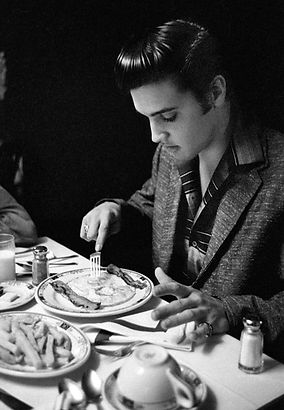
Wertheimer’s fly-on-the-wall approach paid off big-time when he joined Elvis in Virginia three months later. His lens first captures Elvis listening to his ‘boom box’—an RCA transistor radio—in the Richmond train station. There’s a comical series of photos in the dining room of the Jefferson Hotel, with titles like Bacon and Eggs with French Fries, that document Elvis’ indecision about what to order and a friendly flirting session with the waitress.


Elvis—or, more likely, the Colonel—liked Richmond. This was the singer’s fifth appearance in more than a year at the Mosque, now called the Altria Theater. Referred to as “Richmond’s most bizarre building,” this ornate replica of a Muslim temple opened in October 1927, boasting a 3,300-seat auditorium adorned with Saracenic decorations and imported ornamental tile.

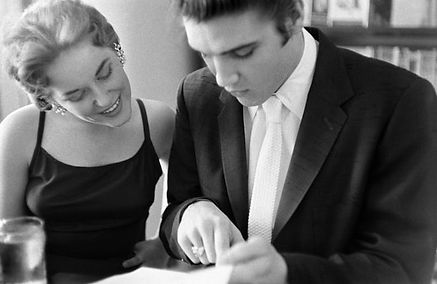
When Wertheimer saw the singer before the start of the first of two shows at the Mosque, “this girl appears. The mystery girl. The everywoman. She’s there in all of her high heels. She was in the coffeehouse of the Jefferson with him, around 4:30.” He believed that the same woman had been in the lobby when Elvis checked in earlier in the day. As Wertheimer once said of the shorthaired, shapely beauty in an essay, “She wasn’t interested in a quick lettuce and tomato. She was dressed for Saturday night.”
Wertheimer began snapping away as the couple cooed at the counter. “He had a bowl of soup, which he wasn’t seriously eating, and he was showing her the script to The Steve Allen Show that he was about to appear in. She seemed rather impressed by all of that.” He remembers Elvis reassuring his companion, “‘Oh, he’s the photographer, that’s okay,’… as if to say it’s only natural to have a photographer on a date. He set the script aside and finished his [soup], and he turned his full attention to her, talking about how nice her hair was and how pretty her earrings were. He was sweet and natural.”

Soon, road manager Junior Smith signaled time to go. “We got to the backstage of the Mosque theater,” Wertheimer said, “and there were a whole bunch of girls in proper dresses—no blue jeans in the crowd. And everyone wanted to be photographed with Elvis.” He noticed Colonel Tom Parker keeping a close eye over ticket sales and opening up bundles of programs for the vendors in the lobby.
Wertheimer remembers Elvis rehearsing with his back-up singing group, the Jordanaires. “But the girls outside the Mosque were screaming so loudly that they couldn’t hear themselves sing. So Elvis went to the window and told them to tone it down. ‘We’re trying to rehearse in here.’ And it worked, they got quiet.”

When Presley had appeared at the theater three months earlier, it was as part of a multi-artist caravan. This time, he was the headline act—the star. On the support bill was a magician, a song-and-dance team, square dancers and a pair of musical comedians—all designed to fill time. “Elvis’ job was to come in the last 20 minutes of this hour-and-a-half show and close it down,” the photographer recalls. “There would be a lot of filler.”
Wertheimer stopped to take photos of the Jordanaires and briefly lost sight of the star. “Elvis disappeared on me. I’m saying, ‘Al, you aren’t here to photograph the other musicians. Where is he?’ Now I’m hunting for Elvis.
“So I’m going down the fire stairs backstage ... and at the end of this long corridor, there were these two figures in silhouette. And I can just make them out. It’s Elvis and the girl.
“There is one small window behind them and then a 50-watt light bulb above their heads. That’s it—I call it available darkness. Because if you used a flash or used any kind of supplemental light, it would have killed the scene, the mood. With all of my practice of available light photography, this was going to be my moment.”
At first, the photographer’s concern was this: “If I start interfering in Elvis’ private life, he might get angry and ask me to leave, and that’s the end of my story. I didn’t want that to happen. On the other hand, I was there to do the story. And that [dalliance] was part of the story.”

![Elvis and Bobbi Owen [Barbara Gray]](https://static.wixstatic.com/media/8257f7_6454f73257f14669ba1afe1f59a285fa~mv2.jpg/v1/fill/w_437,h_615,al_c,q_80,usm_0.66_1.00_0.01,enc_avif,quality_auto/Elvis%20and%20Bobbi%20Owen%20%5BBarbara%20Gray%5D-6_ed.jpg)
Wertheimer did his “yoga breathing” and squeezed off a couple of frames. “Then I realized, ‘Al, you’re not close enough. You’ve got to get closer.’ I’m about 10 feet away at this point. So I see this railing and I decide to go Hollywood. And I climb up on the railing and I figure that Elvis is going to see me and he’s either going to object or not. But he doesn’t see anything except the girl. And by golly, he was going to get that kiss if it killed him … or her.”


Wertheimer climbed up the railing and began shooting over the girl’s shoulder and into Elvis’ face. “But, of course, photographers are never satisfied with their position. They always want a better vantage point. I see this landing on the other side of them, about two or three steps down. So I decide to become the building maintenance man—I say, ‘Excuse me sir, excuse me, coming through.’ They just don’t pay any attention to me. I come through and get settled to where I want to be.
“That’s when she says, ‘Elvis, I betcha can’t kiss me.’ And she sticks out her tongue, and I’m ready for her, snapping away. Elvis says, ‘Betcha I can.’ He’s playing her game. Then he comes in a little too hard and bends her nose. I didn’t see that until the film was developed but there’s a sequence of photographs where Elvis is leaning on this rigid figure. There’s this bent nose shot, which I love.”
Then, the moment. “He backs off, and comes in for a perfect landing, tongue to tongue.”
_edited.jpg)
The touch lasted for maybe half-a-second, Wertheimer said. He remembers putting his camera away, confident he’d captured something special. “I can’t do any better than that, I thought. Leave the lovebirds alone.” He joined Elvis’ band members on the other side of the stage. “All of a sudden, I heard a chorus of voices from the audience: ‘We want Elvis, we want Elvis.’ Apparently, the crowd of girls—most of them were girls—were tired of the filler and wanted the real thing. That’s when Elvis appeared. He finally got his kiss. Now he’s ready to do the performance.”
In all of the hubbub, Wertheimer lost sight of the girl. “She definitely stayed around for the rest of the show,” he said. But then she disappeared. Years ago, a lady claiming to be “the everywoman” threatened to sue the photographer for back royalties, but her claim was quickly disproved. “There [was] a rumor that the girl worked for an Atlanta record company and came up for the day to meet Elvis,” Wertheimer said, but it was never substantiated. Even when that unforgettable kiss she shared with Elvis was popularized on posters and featured in magazines around the world, the mystery girl never surfaced to tell her story. All we have of her is captured on Wertheimer’s negative.
That early point in his career, the 21-year-old Elvis had something to prove. And Wertheimer, no fan of rock ’n’ roll, was amazed at what he saw on stage—and in the crowd—at the Mosque performance. “Elvis let it all hang out. He permitted the girls to see his vulnerability, and they loved that. They would clutch each other, and he brought tears of joy to their eyes. I had never seen that before. It was like a religious experience for them, and a sexual one.”


After the first show, there was an hour to kill, and a reporter came up to ask questions. Wertheimer resumed shooting. “[Elvis] was sitting at the drums and he tapped away with the drumsticks as the theater was emptied out. A young girl, maybe 8 years old, was sitting next to him.” As we see from Wertheimer’s pictures, the girl is in her fancy dress and banging away on the drums while the reporter tries to get quotes from an amused Presley. “When that was finished, he asked the little girl if she wanted to learn how to play the piano. ‘Oh, I’d like that,’ she said. So he takes her down to the orchestra pit where the piano is. And Elvis leans back on his piano stool and he starts banging away with his feet while she played chopsticks. The two of them were making music together.”
.jpg)


After the second show, the star disappeared in the wings. “Somebody said, ‘Elvis has left the building.’ The crowd didn’t believe them. ‘We want Elvis!’ they shouted. The musicians played another number and Elvis didn’t appear. Finally, the music stopped and they started packing up their instruments.”
Where was Elvis? “He was in a police paddy wagon, hiding.” Wertheimer soon joined him, and he and Elvis drove with sirens blaring to the Richmond train station, the photographer’s camera clicking all the way.
When motoring to my favorite fast-food restaurant for breakfast on a February morning in 2010 listening to WTMA, the local talk outlet, the conversation caught my attention. The host, Richard Todd, was discussing photographs taken way back in 1956 (the same year of my youthful days at WTUP) by a photographer named Alfred Wertheimer. Those photos featured Elvis and an attractive young lady at a concert at the Richmond Mosque (the same venue where I had promoted so many concerts while at WLEE) in 1956.


A couple of the photos in particular, had become quite famous . . . images of Elvis apparently attempting to kiss the young lady.
Actress Diane Keaton had called it the sexiest picture in the world. These images have been reproduced many times over the years, in books, on TV, coffee cups, on the net, even displayed at the Smithsonian Museum. But the interesting thing was…the lady in question in the photos had never been identified. Mr. Wertheimer had said that a number of women had contacted him, claiming to be the person he had labeled his “Mystery Kisser.” None had been able to pass his screening questions pertaining to the event. She had remained a mystery all those years. This lady on the radio, was now making that claim . . . that she was the “mystery kisser.” I cranked up the volume, and was really beginning to believe her rambling tale, when she made what I thought was a fatal error. She mispronounced the name of the Richmond Mosque. So, I phoned the station and disputed her claim. She, in turn, said that I was full of baloney. I was intrigued, so I dialed the station again and got her phone number. A couple of hours later, I called, and we enjoyed a lengthy get-acquainted conversation. I made an appointment to visit with her in a couple of days.
She turned out to be a charming and gracious lady, then 74 years old. She said that she had made contact with Mr. Wertheimer quite a number of years previously but became so frustrated with his questions that she had given up in disgust, and never spoken to him again. After our short chat, I asked her permission to record our conversation, and she proceeded to spin her yarn. Here’s the story she told.


none of these girls is Barbara, friends of . . .
On June 28, 1956, Elvis played a date at the baseball stadium in Charleston, South Carolina. Our “mystery kisser” lady had been on a date with friends that night. They did not attend the concert. In fact, she said she had never heard of Elvis Presley. In conversation her friends told of his appearance in town and got her attention with the fact that he was very handsome. Her friends also knew that he was staying at the nearby Francis Marion hotel. Perhaps the cocktails were responsible, but for whatever reason she was influenced to attempt to call Elvis. According to her, there was one drawback . . . she had been told that he wore mascara, and she thought he might be “queer” and why would she want to talk to him? Her companion described Elvis and egged her on to make the call. Surprisingly, the hotel rang his room and a person named Gene Smith answered. “Would she like to speak to Elvis?” “Sure.” She did not recall specifics of the conversation. Again, the alcohol perhaps. She did remember that Elvis told her he was leaving for Richmond the next morning. She replied that coincidentally she was leaving for Philadelphia the next morning. He said that he had an early departure, but that he wanted to meet her, and would send a car to pick her up. She agreed and gave him her address. She went back to her friends and promptly forgot all about it.


The next morning, she was all packed when there was a knock. She answered, and there was this little skinny guy, Gene Smith, who said he was there to take her to Richmond. She remembers the automobile as a big, white Cadillac convertible. She did not recall the name of the other guy who was there, but that he was the “road manager” and he drove the car. A song came on the radio, and she commented that she thought it was awful, with all that echo. (At the time she was a fan of jazz and pop, not rock & roll). Gene told her that that was Elvis, and she backtracked a bit saying that it was just the echo she found offensive. I asked if the guys talked much about Elvis on the drive. She replied no, but that she didn’t know anything about him anyway, so it didn’t matter. Her thought was that they were likely observing “Hands off the girls. The girls were for Elvis.”

On arrival in Richmond, they dropped her off at her aunt’s house, telling her they were going to the hotel to join Elvis and would call her and pick her up. The next afternoon, they called to tell her that Elvis was in the hotel lobby. They informed her that there were too many kids around the hotel, and they could not get their car out, so they would send a taxi for her. When I asked her the name of the hotel, she did not remember even though she had heard it recently. (I remembered well the Jefferson hotel where most acts stayed when performing
![Elvis and Bobbi Owen [Barbara Gray] Jefferson Hotel June 30, 1956.](https://static.wixstatic.com/media/8257f7_30438a120f6b40a4ae1e959b9b962ce0~mv2.jpg/v1/fill/w_588,h_738,al_c,q_85,usm_0.66_1.00_0.01,enc_avif,quality_auto/Elvis%20and%20Bobbi%20Owen%20%5BBarbara%20Gray%5D%20at%20the%20Jefferson%20Hotel%20Coffee%20Shop_%20June%2030%2C%201956_-1_j.jpg)
in Richmond from my days there, and that was where Elvis stayed). Her cab pulled up in front of the hotel, and the same skinny boy of the day before was out front. They walked into what she described as a soda fountain, and Elvis was sitting with his back to her at the counter. Gene spoke to Elvis, “The girl is here.”When Elvis turned her first thought on seeing him was that he was really nice looking, but she was still not comfortable with the situation. Elvis gave her a hug, and she sat down, and they started to talk. He asked who she was and where she was from. She thought him kind of arrogant, stand-offish, a bit cocky.


He asked her if she wanted a beer. “No.” And he said, “Well, that’s good because he wouldn’t let his women drink.” She retorted that she was not his woman and that he didn’t have any right to tell her what to do. He then asked her if she smoked. Again, “No.”

“That’s good, because I don’t let my women smoke.” She repeated that she was not his woman, and if she wanted to smoke or have a beer she would. She thinks it might have “set him off a bit . . . got him interested,” because here was a woman that wasn’t after him.
Their conversation continued, and shortly Elvis said “C’mon, we’re going to the theater for the show,” and she said ok. He then chased her outside the side door and down the street. When asked why she thought he did that she replied that he was apparently just being silly because he knew there was a photographer there (her first mention of being aware that Alfred Wertheimer was present).
They got into the cab and Elvis introduced her to the photographer . . . not by name . . . but just a guy taking pictures. Another person in the cab she identified as Elvis’ cousin Junior. She mentioned that there were many photos taken during the ride to the theater, and later at the auditorium. When they arrived, Elvis told her he was going to jump out first because all the kids would crowd around him, and Gene and Junior would take her in through the rear entrance, which they did. She joined Elvis and the photographer backstage, and she watched as he got ready to perform. She spent time talking with the Jordanaires, and with the Flaim Brothers, an opening act. She said she actually became good friends with the Flaim Brothers, and later exchanged letters.
While the Jordanaires rehearsed, Elvis invited her to walk out in the hallway. They went into one of the adjacent stairwells, and that’s where the most famous pictures were taken. Her recall is that Elvis kept trying to kiss her, and she kept telling him that she had a boyfriend... that he could not, and that she would not kiss him. Then she describes, as part of the silliness, “He stuck his tongue out at me, and in return I stuck my tongue out at him, and we touched.” That became the most famous photograph of all.
When asked if she was aware the photographer was present, she replied that she was not. She did remember that Elvis was tall, and that at one point she had to stand on a step above him. The height difference was an important clue in our efforts to have her confirmed with Wertheimer as his mystery kisser. Apparently all previous applicants for the honor were tall. Our lady was barely five feet and in the photos she wore very high heels, and had to stand on a step up to attain Elvis’ height.


While Elvis was on stage Gene told her that she was to go right out and get in the car and be ready to go, and that Elvis would exit and join them. They were going to the train station because Elvis had to go to New York. (Where he would perform on the Steve Allen show on national television.)
When they arrived at the train, she went alone with Elvis into his private compartment, and he started to “get a little friendlier,” apparently finally a time to make his move. She said that she was getting dizzy just thinking about it. I didn’t ask, but she volunteered that she had on a skinny black dress that was like all the dresses Marilyn Monroe wore, a dress that she had made herself. She admitted she wore no bra but did have on “one of those little plastic girdle things.” Elvis touched that, and he said, “Oh I don’t . . . I can’t . . . I don’t mess with girls that wear girdles.” She assured him that she was not wearing a girdle, and that in no event was he going to “mess with her.” “Oh, come on, go with me to New York.” She declined, reminding Elvis that she was on her way to Philadelphia.
(It was my impression in listening to her retelling of the event all these years later, that perhaps she was uncertain she had made the correct decision).
![Elvis and Bobbi Owen [Barbara Gray]](https://static.wixstatic.com/media/8257f7_f1de776a325b4321a4130d63bd702b2d~mv2.jpg/v1/fill/w_929,h_611,al_c,q_85,usm_0.66_1.00_0.01,enc_avif,quality_auto/Elvis%20and%20Bobbi%20Owen%20%5BBarbara%20Gray%5D-8.jpg)
A knock on the door. An unidentified voice said that the train was leaving, and asked, “Is she going or staying?” Elvis disappointedly replied, “No, she’s staying.”
After those few minutes the train departed with Elvis and entourage, without her. They had gotten her a cab, and she returned to her aunt’s house, and later to Philadelphia. When asked if she ever saw Elvis again, she said that years later he appeared in Philadelphia and that she thought about going to the show but was reluctant because she was older then and she had gained some weight, so she did not go.
Later, back in Charleston she remembers that a friend called to tell her that she was in newspapers all over the country, in pictures with Elvis Presley. That was the first time she ever saw Wertheimer’s snapshots. (Wertheimer’s 1956 photographs did not become particularly well known until after Elvis’ death, at which time they were in much demand. Today, his group of images of Elvis in those few days in 1956 are acknowledged as iconic, and displayed all over the world, from coffee cups to prestigious museums and art galleries).
At the conclusion of her story, I was absolutely convinced that she was, in fact, Wertheimer’s mystery kisser. She professed that her only goal was to be identified publicly as the person in question. I replied that I was acquainted with an author that was internationally famous for several Elvis books, Alanna Nash, and the lady agreed for me to make the contact. Subsequently, I phoned and played the recording of our conversation for Alanna, who immediately became convinced as well that this lady was the long searched for kisser. Later conversations led to an agreement for Alanna to write an article to be placed in a leading national publication, Vanity Fair. Alanna’s bringing the article to fruition would hinge on whether or not Mr. Wertheimer agreed that the lady was the kisser in question.
Several weeks of back-and-forth negotiating took place. Progress, and then nothing. Finally, I took the matter in hand and called Mr. Wertheimer. A lengthy conversation ensued. He expressed considerable skepticism that this newest applicant was the genuine article. This was just the opening volley of a back-and-forth tug of war between the lady, Alanna Nash, and Wertheimer . . . with me attempting to mediate. Conversations, phone calls, meetings, dragged on for the next year and a half. In May 2010 contracts were drawn between the parties involved, which resulted in . . . absolutely nothing. I went back and forth from one to another . . . the lady in question, to Alanna, and later to Vanity Fair to Wertheimer. Frustration and exhaustion overwhelmed me.
Here are several of the photographs given to me by the mystery lady that I in turn furnished both to Vanity Fair and Al Wertheimer, in our attempt to have her identity as the kisser confirmed.


(Author note: Sadly, both Alfred Wertheimer and Barbara Gray have passed since our original publication).

Here’s a typical example of the back-and-forth negotiating with Alfred Wertheimer. Maybe it’s my imagination, but I thought I detected just a tad-bit of hubris on his part.

Barbara Gray 2010
Here’s page one of the May 2010 contract “that went nowhere.” But Wertheimer had finally agreed that our lady was, in fact, his kisser.

.jpg)
Despite all efforts, it just seemed that the story was never going to go public, so I made the very difficult decision to release the saga of the kisser’s story to the world. I did so, via the internet, on a very popular site called Elvis Information Network. Although I told the story, I did not identify the lady. I had doubts that the issues of debate between the parties would ever be resolved. I believed that her identity would likely remain a mystery. However, in January 2011 an agreement was reached for the article in Vanity Fair, and after further lengthy delays the story finally appeared in the September issue that year.

![Elvis and Bobbi Owen [Barbara Gray]_edit](https://static.wixstatic.com/media/8257f7_34198b6c47cf4cf5913f8acfabb45be4~mv2.png/v1/fill/w_331,h_418,al_c,q_85,usm_0.66_1.00_0.01,enc_avif,quality_auto/Elvis%20and%20Bobbi%20Owen%20%5BBarbara%20Gray%5D_edit.png)
Although I missed it, the author Alanna Nash, and the mystery kisser, now publicly identified as Mrs. Barbara “Bobbi” Gray, appeared on the Today show on national television to make the big announcement of the discovery.
Was my name mentioned? Nooo, I don’t think so. Mrs. Gray received a monetary settlement from Mr. Wertheimer and the right to appear and publicly identify herself as the kisser, which she has done. The author, Alanna Nash, received her monetary payment for the article, and acclaim in the media for breaking the story of finding the kisser. Al Wertheimer received a new round of sales of his photographs after the wave of publicity ballyhooing the finding of the kisser. I received…from the kisser, a couple of photos . . . from Al Wertheimer a snub and no further communication. (It’s my opinion that Wertheimer never wanted the kisser identified. He had enjoyed all the limelight for himself). And Alanna Nash, she’s still pissed that I released the story on the net before she could debut it in the magazine and on TV. My regrets, but I’d grown a bit weary.
Reflecting . . . Is it a coincidence that I bumped into Elvis in 1956 in Tupelo? Is it a coincidence that I bumped into this latter Elvis story, which had its origin in an event in 1956? I wasn’t even what you would call an Elvis fan, although I certainly admired his talent and perseverance. I don’t have a clue. Just faded photographs stored long ago in now worn and tattered cardboard boxes. If I were still on the radio, I’d cue up Memories by Elvis.


The Elvis-Kiss Mystery—Solved!
In the summer of 1956, a 21-year-old Elvis Presley, already inciting libidinous mayhem from Kansas City to Jacksonville, impishly touched tongues with a young woman in Richmond, Virginia. Alfred Wertheimer snapped the shutter just at the moment of contact. The result: “The Kiss,” one of the most storied photos in Elvis lore. Yet for five decades, no one, not even Wertheimer, knew the identity of Presley’s date—until now.
By Alanna Nash
December 23, 2013
Several years ago, Malcolm Gray was watching an Elvis Presley tribute show on Pay Per View when a still photograph appeared: the iconic 1956 shot of the 21-year-old rock ‘n’ roll star playfully romancing a blonde fan backstage. Gray’s eyes widened. “My God, come here!” the electrical engineer shouted to his girlfriend, Barbara, now his wife. “They’ve got you on that big screen. Does Priscilla know who you are?”
“No,” Barbara said, nonchalantly, from the other room. She had seen that photo hundreds of times over the past half-century. “I was before Priscilla, Malcolm.”
“The Kiss”—as the photograph is sometimes called—is in fact the most enduring of the 3,800 exposures that photographer Al Wertheimer made of Elvis Presley, many of the best taken during a two-day period in June 1956. While chronicling the rock prince on the threshold of becoming the King, Wertheimer, then 26, famously caught Elvis on the road and at his home in Memphis with his family and entourage. But that prize frame has become one of the classics in the rock-photography canon:
Elvis, in a stairwell at the Mosque Theatre in Richmond, Virginia, minutes before a concert, darting a mischievous tongue toward the deliciously reciprocating mouth of a mysterious girl in black.
Many have compared the picture to another moment snapped 11 years before: Alfred Eisenstaedt’s 1945 “V-J Day in Times Square,” shot for Life, of a sailor and a nurse spontaneously embracing the day World War II ended. But while both images have remained photographic whodunits for decades, nearly 20 people have come forward now and again, purporting to be the subjects in the Times Square shot. In contrast, no one has ever emerged with a legitimate claim as Elvis’s blonde. And with good reason. In the photo, her features are largely obscured. And to make matters more difficult, Elvis, throughout his career, was known to have had scores of dates and trysts with fans and companions.
In the end, after months of negotiation, Bobbi signed the agreement, giving up all commercial rights to one of the most desired photos in rock ’n’ roll.
To decompress, she made a trek to Richmond to revisit the old Mosque Theatre and another to Washington, D.C., to see Wertheimer’s show at the National Portrait Gallery. Her hope was to be photographed in front of “The Kiss” as a memento for her three grandchildren. But when she arrived, she didn’t bother to go in. The crowds were overflowing.