Disc Jockeys, Preachers, and Elvis
by Ron Brandon
Ron Brandon got his start in "radio" when he took a course in the tenth grade in Memphis, passing FCC tests for various licenses such as ham, second class telegraph, and first phone licenses before graduating high school. He went to work for WTUP in Tupelo, Mississippi as their engineer where he would later run the board and be allowed to eventually play some top 40 at odd hours. In September of 1956 Ron was there with a one-track Magnecorder and recorded the afternoon show and an interview with Elvis and his parents. For the show he placed the recorder next to the stage, snaked a mike out in front of the speaker, and taped it. It would be years later before it was heard.

_JPG.jpg)
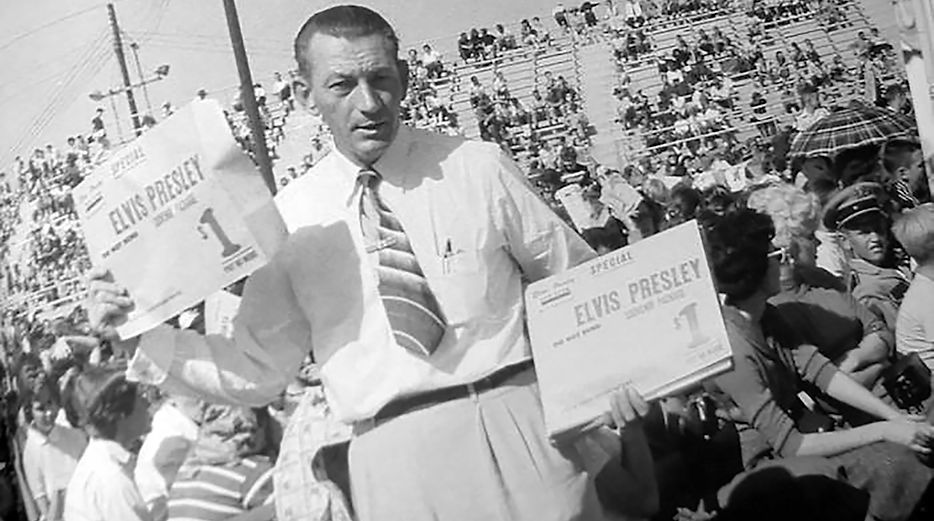


Ron Brandon - DJ / Engineer
In retrospect now having spent 30 years in radio (retired), promoted concerts, and met many "stars" along the way . . . I've never been too much in awe. Most of them were like Elvis . . . gracious and easy to approach. We still thought of Elvis as just a hometown boy and likely at that time had no recognition of what a major star he had become . . . and certainly no inkling of what his legend would be.
Excerpt from Disc Jockeys, Preachers and Elvis by author Ron Brandon who recorded, the now famous, September concert at The Mississippi - Alabama Fair and Dairy Show in Tupelo:
At age 83 this small project had worked its way to number one on my bucket list. Turned out there was a bit more to it than I had anticipated. I joined Facebook a dozen or so years ago, primarily as a vehicle for staying in touch with old radio acquaintances, now scattered from coast to coast. Along the way, because of boredom or stimulation fired up by an old picture or someone’s remembrance, I would occasionally clunk out a few paragraphs. It was fun gathering around the keyboards and screens, much as we had done in person way back then. I had enjoyed reading about your experiences, seeing your photographs, and sharing those memories. Long story short... I had to decide, and here you have it. Digging through cardboard boxes in dark, dank closet recesses, fighting with an ancient computer that refused to acknowledge upgrades... all sorts of mayhem and cusswords, I began committing my memories to paper and history.
I first released this chronicle in book fashion, printed locally, 96 pages. To those of you that purchased and enjoyed it, I thank you. Now, with the encouragement and guidance of an experienced writer/publisher and old friend Dwight Douglas, here’s the latest edition, with far more text and quite a few more pictures and information. I hope that you enjoy reading as much as I did putting it all together. My thanks to each of you for all those years in the radio/ rock & roll business.

Ron Brandon DJ at WTUP in 1956 at age 17

Ron Brandon today at age 87

My first visit to a radio station, WNAU in my hometown New Albany, Mississippi, about 1955


Here's young Ron working on his recording
Just a few months into my employment at WTUP, my boss Jim Reese broke the news that Elvis would be returning to Tupelo for a homecoming concert, to be featured as the major attraction at that year’s Mississippi-Alabama Fair and Dairy Show. To top it off Jim would be the on-stage Master of Ceremonies and as a staff member, I would be invited. Whoa, this was big news! Years later, I found time to research and fully document my participation in the events of that day.
What follows is the story of how Elvis’ homecoming concerts in Tupelo on September 26, 1956, were covertly recorded by the author, how those recordings were saved by Elvis in his closet at Graceland until his death, and why/how you can listen to and see the performance on the web today. Simply search Elvis/Tupelo/1956 and you’ll find it on a number of sites. There’s even one I discovered that has colorized the old video. If you watch, on your screen right in the beginning, the guy along the lower left side of the stage in sunglasses, white shirt, and pipe (which I did not smoke), surrounded by policemen, is the author. You’ll see me get up and mole my way through the crowd to readjust the WTUP mic I had placed in front of the old horn speakers. I operated the recorder for the interviews that WTUP’s Charlie Watts voiced with Elvis, his parents, Nick Adams the actor who was visiting with Elvis, and with Judy Hopper, the young lady who climbed on stage that afternoon. These interviews have been mistakenly credited to Jack Cristil of WELO in every book and recording till this date. As you’ll learn here, WTUP’s Charlie Watts was the announcer who voiced the interviews, and I was the 17-year-old engineer who ran the recorder. And, as I’ll retell, I’m the guilty party who secretly recorded those iconic concerts.
Backtracking in memory, I know that Elvis and I traveled many of the same roads. I was born in a suburb of Tupelo called Endville, just a few miles from Elvis’ East Tupelo home. As a child I lived in New Albany, on the same highway 78 that Elvis and his family traveled when they moved from Tupelo to Memphis. When I was twelve years old, my family also moved to Memphis, following the path of the Presley family. Although Elvis was three years older than me, during our high school years in Memphis we shared similar experiences. I too listened to Dewey Phillips nightly on WHBQ radio, exposing me to Chuck Berry, Little Richard, the new music soon to be labeled rock and roll. I first saw and heard Elvis when he performed from the back of a flat-bed truck at the grand opening of the Lamar-Airways Shopping Center. At one point I lived only a few blocks from the Presleys when they rented a home briefly just off Lamar Avenue. So, I had been exposed to all the Elvis hits from the early days of Sun records and knew of his background in Tupelo.
By the time of the Mississippi-Alabama Fair and Dairy Show in 1956, Elvis had made the move from Sun to RCA records. Heartbreak Hotel and Hound Dog were top of the charts. He’d even announced that a movie was in the works. The Fair was the big annual event in Tupelo, with carnival rides on the midway, a livestock show, and special on-stage entertainment, mostly country music artists. But this year Elvis was going to appear for two shows, with much of the money generated being donated to build a park near his old home place in East Tupelo. I personally had never seen a rock and roll show, so imagine my excitement when WTUP manager Jim Reese told me that he was going to be Master of Ceremonies for the concerts, and that I should set up a recorder alongside the stage to see if we could record an interview with Elvis.
Recorders and microphones in 1956 were not like the lightweight hand-held affairs of today. The Magnecord recorder from WTUP was in two units, each weighing about 25 pounds. The microphone was a large RCA A440 on an adjustable stand, just like you see in many old movies on TV. I saw one on sale recently for $6000, highly valued by collectors. If Elvis had sung into it, well, who knows the price tag?
I had missed the welcoming parade for Elvis a few blocks away in downtown, because I was busy lugging our equipment to the fairgrounds. I set up a small table directly alongside the left side of the stage, knowing that Elvis would have to walk from the tent set up behind the stage, directly past us to get onstage. There was no electric outlet nearby for our recorder, so I had to string a long extension cord across the stage. If you look closely, you can see it in all the photographs.
There was no fire marshal at that time to refuse permission. In fact, there were no official requirements, no permits, no red tape whatever. As time for the afternoon show drew near, the grandstands were full, and the excitement was building. WTUP’s announcer Charlie Watts had arrived and, novice that I was, I was confident that he would know exactly what to do. While waiting, I noticed a fellow placing almost directly in front of us on stage the familiar “His Master’s Voice” RCA logo dog. I assumed this guy must be part of the show, so in all innocence I asked if it would be ok to record the performance, my intention being to play it back later on my radio program. He had no idea who I was since we had no mic flags, banners, or identification of any kind.


His immediate response was an emphatic “Hell no!” Understand, like Elvis I had been brought up to respect my elders, “Yes Sir,” “No Sir,” and I was a bit put off by his abrupt response. (In later years I thought maybe the person on stage was Colonel Parker, who at that time we had never heard of. I now suspect it was Tom Diskin, an associate of Parker, who was in Tupelo and at the Fair that day).
Minutes ticked by… warm-up acts had started the show. Cars were arriving behind the tent dressing room, and with the appearance of each car, excitement in the crowd would surge… only to be disappointed when Elvis did not appear. Someone told me that one of the autos produced the Mississippi Governor. Never having seen a Governor, I was impressed… but the crowd was not. They wanted Elvis.
Finally, in a cloud of dust (literally), a group of cars including two Cadillacs, led by two police vehicles with red lights spinning, arrived, and halted abruptly. Magically Elvis, family, and entourage appeared, but to the disappointment of all quickly disappeared into the backstage tent. Charlie and I were only a few feet away but had no way to drag our bulky mic and recorder back to the tent. So, we waited.


_JPG.jpg)
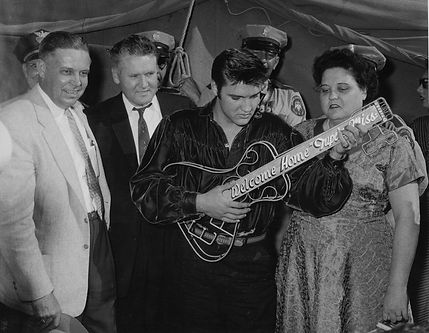
One of the people who arrived with Elvis had gone on stage and was doing impressions of movie stars. He had identified himself as a friend of Elvis, Nick Adams.


Although I had been a huge fan (like all teens of that era including Elvis) of James Dean in the movie Rebel Without A Cause I didn’t recognize Nick as having played one of the roles in that movie. It seemed Charlie had never heard of him either, but when Nick came off stage, Charlie corralled him for an interview.
When you listen to the interview, you’ll hear Nick yell back to Elvis, “What was that your Mother fed me… okra..?” And a quick “Yeah” reply from Elvis.
Nick Adams and Papa John Gordy’s Dixieland Band warm up the crowd, but the crowd wanted Elvis.


WTUP’s Charlie Watts ─
has never received proper credit for his Tupelo interviews, that can be heard today on numerous web sites. Time to set the record straight. Charlie voiced the interviews, and I ran the recorder.
Elvis with Jack Cristil of WELO, September 26, 1956.

The picture above is Elvis with Jack Cristil of WELO. In those days WELO played no rock and roll, including Elvis. Jack was a sports guy and whatever tape he rolled that day has never surfaced. Authors of all stripes over the years have always mistakenly credited Cristil with the interviews, simply because of these and similar photographs. Cristil also did an interview with Elvis when he returned to Tupelo for another concert in 1957. That interview surfaces from time to time which adds to the confusion. (As you’ll read in an upcoming chapter, in later years I worked with Jack Cristil at WELO. Sadly Jack RIP several years ago).
D.J. Fontana, Elvis’ drummer foreground left, with WTUP’s Charlie Watts interviewing the Presleys on the right.

Here is the only photo I’ve ever seen of Charlie and his interview with the Presley parents. This is the first and only time Charlie Watts photograph has ever been credited in print with his interviews. Charlie voiced interviews with Elvis’ Mom and Dad, with Judy Hopper, the young girl who climbed on stage with Elvis during the afternoon show…and finally, with Elvis himself just before he went on stage. My role was to turn the recorder on and off and watch the volume level. And yes, I did get to shake hands and say hello.
It is to my great dismay that Charlie has never been given credit for the interviews. I spoke with Peter Guralnick, author of Last Train To Memphis and Careless Love, The Unmaking Of Elvis Presley, and asked why he had credited Jack Cristil with the interviews. He replied that in his conversations with Cristil it was never directly addressed, and the mistaken assumption was made because of photographs like those above.
Subsequent authors over the years have all made the same mistaken assumption. Now you know the real story. Sadly, Charlie Watts RIP several years ago, after a long broadcast career in Alabama.
Recorded: Wednesday evening, September 26, 1956. At the Mississippi-Alabama Fair and Dairy Show at the Tupelo Fairgrounds, Tupelo, MS.
Interview with Mr. and Mrs. Presley
By Charlie Watts
[Charlie] “What song, first Mr. Presley, uh . . ., is your favorite that Elvis has recorded?”
[Vernon] “Well Sir, it’s a pretty hard to say, uhhh . . . ”
[Charlie] “That’s a (inaudible) question” [Vernon continues] “I think the first one, ‘All Right Mama.’ ”
[Charlie] “Yes sir, is that your favorite?”
[Vernon] “That’s one of them, yeah.”
[Charlie] “One of your favorites, . . . I know their all your favorites!”
[Vernon] “The next one would be, uhhh . . . well, ‘Hound Dog’ and several others I can’t remember.”
[Charlie] “I, I see, do you have a favorite Mrs. Presley?”
[Gladys] “ ‘Baby Let's Play House’ uh,uh . . .” [Vernon] “That’s a good one . . .” [Gladys continues] “And uhhh, ‘Don’t Be Cruel,’ ”
[Charlie interrupting] “ ‘Don’t Be Cruel.’ ” . . . [Gladys continues] “. . . that’s my two favorites.”
[Vernon] “ ‘Don’t Be Cruel,’ Yeah, that’s a good song . . .” [Charlie] “A very good song!”
[Vernon continues] “Like I said, there’s so many of them I can’t remember their names.”
[Charlie] “Yes sir, well I know that you’re just ahh . . . so proud . . . I know that . . . ahh . . . every parent in the world who had a son, as popular and famous as your son, would be equally as proud . . .” [Vernon and Gladys mumbling]
[Charlie continues] “And I say, . . .” [Vernon interrupting] “We certainly are, appreciate all of the good people here, . . . knock yourself out, being so nice to us . . .”
[Charlie] “Yes, sir, I'm certainly do.”
[Vernon] “Especially the police department and the highway patrol . . .”
[Charlie] “They have done an excellent job today, haven’t they sir? [Charlie continues] did you by chance, get a chance to see the parade today?”
[Gladys] “No sir, we didn’t get here in time to see that, we was being (inaudible) by that (inaudible) we was on our home eating dinner.” [Charlie interrupting] “Yes Ma’am!” [Gladys continues] “And what a nice parade they had and I wish then that we'd gotten here in time, we didn’t.”
[Charlie] “That was terrific and everyone was having such a fine time, I-I . . . know that you are sorry you missed it and I know that you heard it was a wonderful parade and in honor of Elvis. Well, I’m sure that you know that the whole town is wide open to the Presley family.”
[Vernon and Gladys] “Thank you very much, thank you, we appreciate it.”
[Charlie] “Well thank you, we have enjoyed talking to you so much and lots of good luck to the both of you here.”
[Vernon and Gladys] “Thank you very much.”
[Charlie] “So very glad to have met you both, Mr. Presley, good night Mrs. Presley.”
[Gladys] “Glad to meet you.”
[Charlie] “Thank you.”
3-2-1 . . ."ACTION"
My impression of Elvis was that he was on top of the world. I have a great mental picture of the jauntiness in his step, the huge grin on his face, his quick stride up to the mic with outstretched hand. He was anxious to get on stage, but patient enough to take a couple of minutes to chat. Then a quick few steps to the stage, the screams of the crowd, and the show was on. Remembering the admonition that no recording was allowed, my 17-years-old pulse was still running a bit hot, and I made a spur of the moment decision that has altered history ever so slightly all these decades later. A quick glance around revealed no “Mr.In-Charge” anywhere in sight. I elbowed my way through the crowd…made sure the mic cord going to the recorder was still connected . . . shoved the small table with the recorder slightly under the stage . . . flipped the switch to “record” and watched the tape reels begin to turn.

Just then Jim Reese on stage was announcing, “Ladies and gentlemen, boys and girls, the moment you’ve all waited for . . .” and Scotty Moore, Bill Black, and D.J. Fontanna were off and running with the first notes of Heartbreak Hotel. I quickly realized I had a problem. The volume meter on the recorder indicated the very highest level. Knowing this would cause distortion, I wormed through the crowd and adjusted the mic that I had placed in front of one of the public address horn speakers. This helped somewhat, but I still suspected that there would be distortion. I couldn’t move the mic further from the speaker, as the girls screaming would completely override the music. To be truthful, there was so much noise I couldn’t be certain from watching the meter just what we were recording.
I’ve been asked why there were gaps in the recording . . . parts missing. In those days, the Magnecord recorder was a one-track machine that recorded at only one speed. The tapes were on reels, each with a recording time of a bit over 30 minutes. When one reel would finish, I would have to rewind it, take it off the machine, place a new reel of tape on and thread it to the take-up reel, a procedure that in the confusion and jostling of the crowd could take several minutes.
My impression of the concerts can best be described in one word, fun! Unlike the huge productions at today’s concert events, these were just the opposite. I don’t believe that much of anything had been planned. Elvis was in total control, and he appeared to have only one train of thought, “Let’s have fun!” I wondered if Scotty and Bill, or the Jordanaires, knew what songs were going to be featured, or in what order. Perhaps they had played previous shows so often that it was all familiar to them. Certainly, all the songs were well known, since they had all been hits in the mid-South area from the beginning of Sun Records through the newest releases on RCA. Elvis performed for the crowd, responded to the crowd, and seemed to have little awareness of anything else. Occasionally he would glance my way and smile as if to say, “This is just about as good as it gets!” Then he would quickly move away across the stage.

_JPG.jpg)
.jpg)

"When Elvis leaned down I thought he said something, and I wondered if he was objecting to my recording, but with all the noise I simply could not hear. He just smiled."
In my opinion the afternoon show (and that’s the one you see from the Movie-Tone video, and today available on many sites on the net) was the better of the two. In the afternoont was totally no-holds-barred. There were no problems if you don’t include the girls screaming constantly and drowning the music. In my opinion the multitude of police on hand was not needed. Even the incident with Judy Hopper climbing on stage was very subdued. When Charlie interviewed her later, she was a really nice kid, with no idea of why she had done it.
She actually Hopped, indeed, right into Presley's lap . . .
_JPG.jpg)


One aspect of the concerts that got my attention was the total lack of any formality, or structure. Various photographers wandered about on stage at will. There were no backstage passes in those days . . . in fact, no identification on anyone of any type. The cops had no real idea of why they were there, and rarely seemed to know just what to do. In reality there was really very little for them to do. All was exceptionally casual. The only pause in the fun during the afternoon show was the hokey awards presentation from the Governor and Mayor . . . which Elvis patiently tolerated. All the songs were pure rock and roll from his growing lineup of golden hits, with one exception. I’m not sure that he had ever performed Love Me Tender in concert before, and I thought there was a bit of hesitation in his delivery. But it came off well . . . and the audience loved it. Then back to the rockers . . . and all too soon . . . the extended version of Hound Dog that closed the show. There was no encore, and Elvis quickly left the stage and headed for the automobiles parked nearby.

The Presley entourage were guests of Mr. Ike Savery, a local businessman who had helped sponsor the show. Charlie Watts had earlier returned to the radio station to take care of other duties. I hung around to watch over our equipment . . . chatted with a few fans . . . and killed time until the evening performance. Just before that night’s show Charlie reappeared and we managed to interview Elvis’ parents, Vernon and Gladys. I thought Mrs. Presley was almost in shock. Making the transition from their humble background in East Tupelo to being welcomed back as celebrities, was simply too large a hurdle for her. Mr. Presley, on the other hand, seemed to relish the moment, perhaps enjoying a moment of payback, “We’re showing them,” while recalling memories of sour relationships and unpleasant experiences not so many years before. (Years later and after many hours or research it has been confirmed with some certainty that this interview with Mrs. Presley is the only known recording of her voice).
.jpg)

September 26, 1956 - Tupelo Miss., Gladys toured the city and received gifts from locals. - above - the necklace Gladys' wore with a photograph of Elvis.


Some have said they thought the evening show was better, but I disagree. Basically, it was the same songs and presentation with the same reaction from the crowd. But the audience at night was a bit older. Perhaps someone had cautioned Elvis about crowd control, as several times he asked, with little result, the girls crowding the stage to please sit down. That night, in addition to the large contingent of Mississippi State Police, there were uniformed members of the National Guard lining the front of the stage. All totally unnecessary in my opinion. To me, Elvis seemed a bit more subdued during the evening show . . . not quite as spontaneous and reactive to the crowd. My original intent was to not record this second show, but when the time came, I thought, “Why not?” So once again, I flipped the switch to “record” and watched the spinning reels begin to capture the moment. All too soon, after the final slow grindings of Hound Dog Elvis left the stage. He and entourage were soon back in the Cadillacs and headed for the twists and turns of Highway 78 (no interstate freeways in those days) and about a ninety-minute drive home to Memphis. (There are many sites on the net where you can hear the audio of both shows, but the video is only of the afternoon show). I collected our gear and returned to the radio station, just a few minutes from the fairgrounds. I was tired, but grateful for a really exciting day, and I was looking forward to the next afternoon when I could play back my recordings on my radio show.
In discussing that September day in 1956, someone will occasionally ask, why did we not place more importance on the recordings, or why did we not make any pictures . . . why this, why that? The answer is simple. We . . . not one of us . . . had any thought whatever that a truly important event was taking place. Not one of us in our wildest imagination could foresee that many decades in the future anyone would know the name Elvis Presley . . . that anyone would want to hear his music, or any music of that era. The older generation of 1956 widely disliked rock and roll, and while curious about Elvis, many (even in Tupelo) were of the opinion that his talent was marginal. Quite a few expressed an opinion that they thought he might have a few good months . . . maybe even a couple of years . . . but a quick disappearance from the headlines was likely. And in conversations with some of the locals, I thought I detected more than a hint of jealousy.
─ Ron Brandon


.jpg)